Under the Hood: How MTN TV by AfroMobile Is Built
A developer’s look under the hood of MTN TV by AfroMobile, exploring the OTT architecture, streaming technology, telecom integrations and the European technology platform helping power Uganda’s newest digital entertainment service.
Inside Uganda’s new streaming platform, the technology behind it, and what a look beneath the interface reveals about modern OTT architecture.
When a new digital product launches, most users are interested in what it can do.
Developers tend to ask a different question:
How does it actually work?
That was my reaction when I came across MTN TV by AfroMobile, the newly launched digital entertainment platform from MTN Uganda and AfroMobile.
The service brings live television, radio, movies, sports and on-demand content into a single streaming experience, with access through mobile applications and the web. MTN Uganda describes the platform as a partnership with AfroMobile, combining MTN’s digital reach with AfroMobile’s expertise in content aggregation and streaming technology.
But behind the polished interface is a much more interesting engineering problem.
Streaming television to potentially millions of mobile users isn't simply a matter of putting video files on a server and adding a play button. It requires a collection of systems working together: content ingestion, transcoding, adaptive streaming, content management, subscriber authentication, digital rights management, billing, APIs and large-scale content distribution.
So I decided to look beyond the interface.
I created an account, used the service, inspected its network activity through the browser's developer tools and then compared what I could observe with the publicly documented capabilities of the technology platforms involved.
What emerges is a fascinating example of how a modern OTT platform can combine local content, telecom infrastructure and an international streaming technology stack.
A note on the architecture: MTN Uganda and AfroMobile have not publicly released a complete technical architecture diagram for MTN TV. Some of the implementation details discussed in this article are therefore based on publicly available information and observations of the application's behaviour, while others are engineering inferences about how such a system is likely to be implemented. They should not be interpreted as a disclosure of MTN's private infrastructure.
MTN TV Is a Partnership, Not Simply a New MTN App
One of the easiest ways to misunderstand MTN TV is to look at the branding and assume that MTN simply built a television application internally.
The reality is more interesting.
MTN Uganda launched MTN TV in partnership with AfroMobile, with MTN providing its telecommunications and technology ecosystem while AfroMobile brings content aggregation and streaming expertise. MTN's own announcement describes the platform as a collaboration between the two companies.
The platform's terms and conditions provide an even clearer picture of the relationship. They identify MTN TV by AfroMobile as a digital content distribution service and state that the content is owned by Afro Mobile Media, its licensors, content partners, broadcasters and other rights holders. The same terms describe MTN Uganda as acting as a technology facilitator and application developer.
That division of responsibilities is important because it immediately suggests that MTN TV isn't a monolithic application.
Instead, it is better understood as an ecosystem.
At a high level, we can think about it as:
Content providers → AfroMobile → OTT platform → MTN technology/network → viewer
The interesting question is what sits in the middle.
The European Technology Connection
This is where the investigation gets particularly interesting.
A significant part of the architecture appears to align with the capabilities of moTV.eu, a European company headquartered in Prague that develops white-label OTT/IPTV infrastructure. The company also lists an African office in Kigali, Rwanda.
moTV.eu describes its product as a complete, scalable OTT/IPTV platform rather than simply a video player.
Its publicly documented technology stack includes:
- Content management
- Subscriber management
- Transcoding
- Multi-bitrate encoding
- Adaptive bitrate streaming
- HLS
- MPEG-DASH
- DRM
- Google Widevine
- EPG
- Payment integration
- APIs
- CDN integration
- Streaming servers
- Analytics
- Mobile and TV applications
It also describes its platform as a white-label solution, allowing operators to launch streaming services under their own branding.
That is significant.
A company launching a national streaming platform does not necessarily need to build every component of an OTT infrastructure from scratch. A mature platform can provide the underlying machinery while the local partners focus on content, branding, distribution and the customer relationship.
And that appears to be the model worth examining in MTN TV.
Rather than thinking of MTN TV as a single application, it makes more sense to think of it as several systems assembled into one customer-facing product.
What Happens When You Press Play?
Let's start with the part users see most clearly: the video.
When you select a live television channel, the application doesn't simply download one enormous video file.
Live streaming is normally a pipeline.
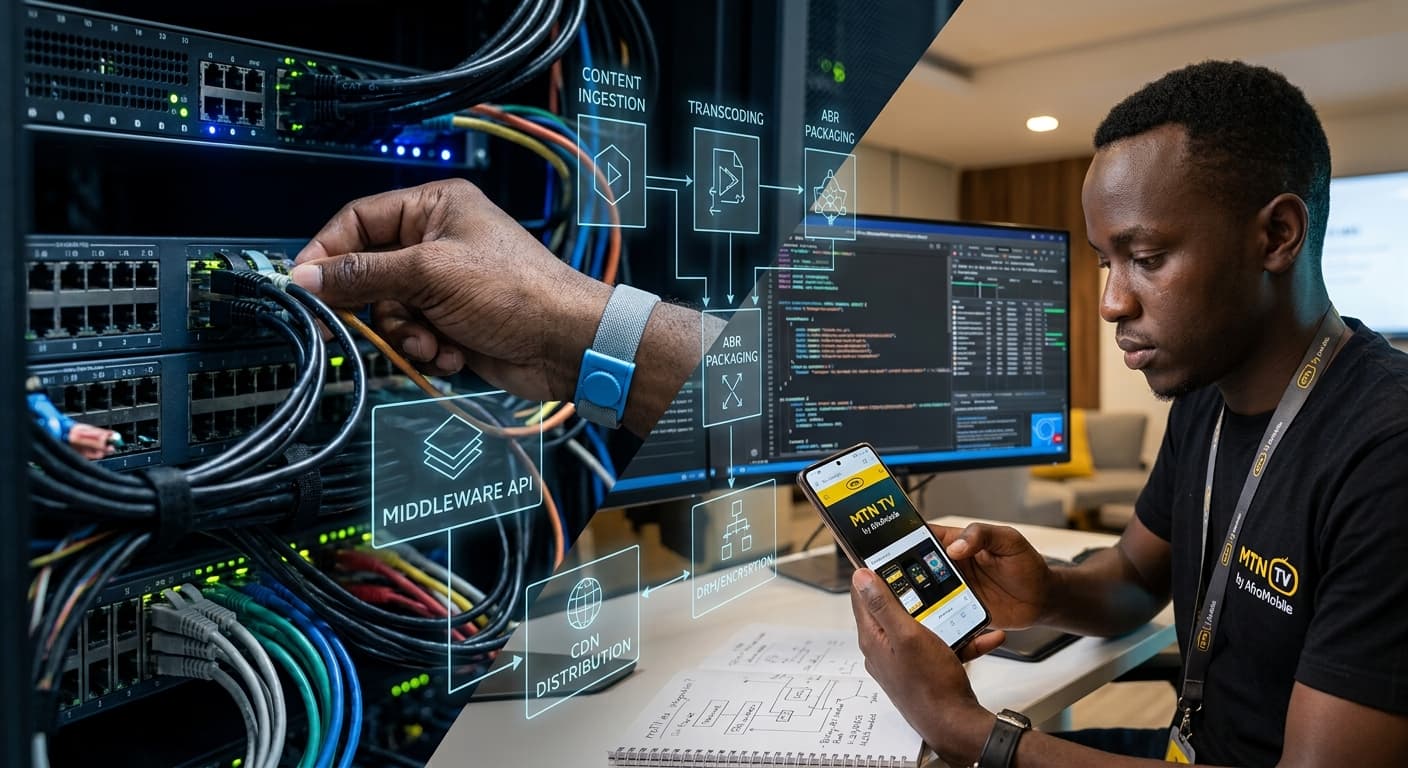
A simplified version looks something like this:
Broadcast Feed
↓
Ingestion
↓
Encoding / Transcoding
↓
Adaptive Bitrate Packaging
↓
DRM / Access Control
↓
CDN / Edge Distribution
↓
MTN TV Application
↓
Your Device
The source may originate from a broadcaster or other content provider. That source then has to be converted into formats suitable for delivery over the internet.
This is where transcoding becomes important.
Phase 1: Turning Broadcast Video Into Internet Video
A television broadcast is not necessarily formatted for delivery to an Android phone connected through a mobile network.
The video therefore needs to be processed.
A streaming platform can take an incoming feed and generate multiple versions of the same content at different bitrates and resolutions.
For example, conceptually, the same channel might have representations such as:
- Low bitrate for poor connections
- Medium bitrate for typical mobile connections
- Higher bitrate for faster connections
- High-definition representations for capable devices
The player can then choose the appropriate representation based on current network conditions.
This is known as Adaptive Bitrate Streaming (ABR).
The effect is something most users experience without thinking about it.
You might start watching a channel on a strong 4G connection in Kampala. The player can request a relatively high-quality stream.
Move into an area with weaker connectivity and the player can switch to a lower-bitrate representation.
The objective isn't necessarily to maintain perfect picture quality.
It is to keep the video playing.
moTV.eu publicly documents multi-bitrate encoding and adaptive bitrate streaming as part of its OTT platform, including delivery through HLS and MPEG-DASH.
HLS and MPEG-DASH: The Video Isn't Really "One Video"
Developers who inspect streaming applications through browser developer tools will often notice that the browser isn't downloading a giant .mp4 file.
Instead, the player typically works with a manifest that describes available streams and then requests media segments as playback progresses.
Two widely used approaches are:
HLS — HTTP Live Streaming
and
MPEG-DASH — Dynamic Adaptive Streaming over HTTP
Both allow a player to discover different representations of a stream and request the appropriate segments.
This is one of the reasons modern streaming platforms can operate over unpredictable networks.
Instead of requiring a single fixed stream, the player can effectively say:
"Given the device and network conditions I have right now, which version of this stream should I request?"
That decision happens continuously during playback.
moTV.eu publicly lists HLS, low-latency HLS and MPEG-DASH among its supported streaming protocols.
Phase 2: The Middleware Is Where Things Get Interesting
Video delivery is only one part of the problem.
A streaming service also needs to know:
- Which channels exist
- Which programmes are currently playing
- Which content a user can access
- Which subscription package the user has
- What content should appear on the home screen
- Which devices are allowed
- What metadata belongs to a particular programme
- What subscription options are available
- Which content should be restricted
This is where middleware becomes important.
moTV.eu describes its middleware as the central software layer for managing content, customers, subscriptions, packages, services and billing. Its documented management functions also include channels, EPG, VOD, applications, users, packages, payment integration and APIs.
In other words, the middleware is not the video itself.
It is the system coordinating the business and technical rules around the video.
Think of it as the control plane of the streaming service.
The EPG: Why the App Knows What Is Playing
If you've used a traditional television decoder, you've probably seen an Electronic Program Guide, or EPG.
The EPG provides information such as:
- Channel name
- Current programme
- Programme description
- Start time
- End time
- Upcoming programmes
In an OTT environment, that information becomes another piece of structured metadata managed by the platform.
A streaming application can therefore combine the actual video stream with metadata retrieved through APIs.
The result is the familiar interface where you can browse channels and see what's currently playing or coming next.
moTV.eu lists EPG as part of both its content management and middleware capabilities.
Phase 3: Authentication and Subscriber Access
The next question is obvious:
How does the platform know who is allowed to watch?
When you create an account and authenticate, the application needs to establish an identity that can be associated with your subscription and access rights.
From observing the application's behaviour, it is clear that the frontend communicates with backend services to perform account and service-related operations.
The exact internal authentication architecture is not publicly documented in enough detail to say precisely which MTN identity systems are involved at every stage.
However, this type of integration is exactly what we would expect in a telecom-backed OTT service.
A typical architecture could involve:
User
↓
MTN TV Application
↓
Authentication / API Layer
↓
Subscriber System
↓
Subscription / Entitlement Check
↓
Content Access
The important concept here is entitlement.
Logging into the application doesn't automatically mean you should be allowed to play every piece of content.
The backend must determine what the subscriber is entitled to access.
That decision can happen before a stream is issued or through access controls associated with the playback session.
Subscription and Billing: Where OTT Meets Telecom
A streaming service also needs to answer another question:
Has this user paid for the service?
For a telecom operator, the integration can become particularly interesting because the operator already has an established subscriber and billing ecosystem.
A subscription request can potentially pass through an API layer connecting the streaming platform with the operator's billing or payment systems.
The exact implementation used by MTN TV is not publicly documented in sufficient detail to describe every internal API or transaction path as fact.
But the architecture is straightforward conceptually:
Customer
↓
MTN TV
↓
Subscription API
↓
Billing / Payment System
↓
Subscription Status
↓
Content Entitlement
This is another area where a modular OTT platform becomes useful.
moTV.eu publicly documents subscriber management, subscription packages, billing capabilities and payment integration within its platform.
DRM: Because Streaming Premium Content Is a Security Problem
There is another component that becomes essential once valuable television content is being distributed over the internet:
Digital Rights Management (DRM).
Without adequate protection, a streaming platform would have a much harder time preventing unauthorized redistribution of premium content.
DRM changes the architecture from:
"Here is a video URL."
to something closer to:
"Here is an encrypted stream that an authorized player can obtain the necessary licence to decrypt."
moTV.eu publicly states that its platform supports DRM through Google Widevine and Apple FairPlay, with DRM integrated into its transcoding and streaming architecture.
MTN TV's own terms also explicitly prohibit users from circumventing security features, encryption technology, access controls or DRM systems implemented by the service.
That doesn't reveal the complete implementation, but it does confirm that security and access control are fundamental parts of the service.
The CDN: Getting the Video to Your Phone
Even after video has been transcoded and protected, there is still a major problem:
How do you deliver it to thousands or potentially millions of viewers without sending every request back to one central server?
This is where the Content Delivery Network (CDN) comes in.
A CDN distributes content across multiple locations so that users can retrieve data from infrastructure closer to them.
The simplified model is:
Origin
↓
CDN
↓
Edge Servers
↓
Users
This matters enormously for live television.
Imagine thousands of people watching the same football match.
Without an efficient distribution layer, the origin infrastructure could become a bottleneck.
With a CDN architecture, large amounts of repeated content can be distributed through edge infrastructure.
moTV.eu explicitly documents CDN integration and describes its platform as supporting third-party CDN providers as well as its own distribution software.
That also means the exact CDN infrastructure used by a particular deployment does not necessarily have to be identical to the architecture shown on the vendor's public website.
A production deployment can be customized.
And Then There Is MTN's Network
This is where MTN's role becomes particularly important.
A conventional streaming company has to worry about getting video across the public internet.
A telecom operator already owns and operates a massive access network.
That creates opportunities for deeper integration between the OTT service and the telecommunications infrastructure.
For MTN TV, this can include subscriber identification, connectivity, billing and data-package integration.
One particularly interesting feature is the relationship between the service and MTN's data bundles.
If a subscriber receives a package that provides dedicated or zero-rated access to MTN TV, the network needs some mechanism for identifying eligible traffic and applying the appropriate charging policy.
There are several ways telecom networks can implement such policies.
It would therefore be premature to state that a particular mechanism—such as Deep Packet Inspection—is definitely being used for MTN TV without confirmation from MTN.
The safer conclusion is that the service requires network-level integration capable of distinguishing eligible MTN TV traffic from ordinary subscriber data, while the exact implementation remains an infrastructure detail that MTN has not publicly disclosed.
This distinction matters.
As developers, we should be comfortable saying:
"This is what we observed."
and:
"This is what the architecture would reasonably require."
without turning the second statement into the first.
Looking at the Application Through a Developer's Eyes
This is probably the most interesting part of the entire exercise.
To a normal user, MTN TV is simply an application.
To a developer, the browser reveals another layer.
Open Developer Tools.
Go to the Network tab.
Start interacting with the application.
Suddenly the interface becomes a collection of requests.
Login operations become API calls.
Content becomes metadata.
Channels become backend resources.
Subscriptions become service requests.
Playback becomes a sequence of manifest and media requests.
The polished UI is simply the visible layer sitting on top of a much larger distributed system.
That is an important lesson for developers.
Modern applications increasingly work this way.
The frontend is rarely the product by itself.
It is an orchestration layer communicating with APIs, authentication services, content systems, payment services, storage systems, analytics platforms and infrastructure.
A streaming platform makes that architecture particularly visible because video delivery introduces an additional set of specialized systems.
A Reasonable Architecture Model
Based on the publicly available information, the technology capabilities documented by moTV.eu, MTN and AfroMobile's descriptions of their respective roles, and observations from interacting with the platform, a simplified architecture could look something like this:
Broadcasters & Content Partners
↓
Content Ingestion
↓
AfroMobile / Content Management
↓
OTT Middleware & Subscriber Systems
↓
Transcoding + ABR Packaging
↓
DRM / Access Control
↓
CDN / Streaming Infrastructure
↓
MTN Network & Service Integration
↓
MTN TV Web / Android / iOS
↓
Viewer
This should not be interpreted as MTN's official architecture diagram.
It is a developer's model of the systems that appear to be required to deliver the service, informed by the capabilities publicly documented by the technology providers.
The interesting part is how many independent concerns have to work together to make pressing a simple Play button possible.
Why This Architecture Makes Sense
Building every part of a modern OTT platform internally is expensive and time-consuming.
A company would have to build or integrate:
- Video ingestion
- Transcoding
- Storage
- Streaming
- CDN infrastructure
- DRM
- Content management
- Subscriber management
- Authentication
- Billing
- Applications
- Analytics
- EPG
- Monitoring
- APIs
- Device compatibility
A mature OTT platform can provide many of these components as a pre-integrated system.
That appears to be the value of a platform such as moTV.eu.
The company describes its offering as an end-to-end OTT/IPTV solution with modules for transcoding, middleware, streaming servers, applications, CMS, subscriber management, EPG and DRM. It also describes its platform as scalable from smaller deployments to services with hundreds of thousands of customers.
For a service entering a market such as Uganda, this approach can dramatically reduce the amount of infrastructure that needs to be engineered from scratch.
The local partners can concentrate on what differentiates the service:
content, customers, branding, distribution and market access.
The underlying OTT machinery can come from a platform already designed for the job.
The Bigger Lesson for Developers
For me, the most interesting thing about MTN TV isn't actually the television channels.
It is the architecture.
We often look at applications such as Netflix, YouTube, Spotify or local streaming platforms and think of them as single products.
They aren't.
They are ecosystems of systems.
A button on the frontend can trigger a chain that crosses multiple services:
Frontend
→ API
→ Authentication
→ Subscriber Management
→ Entitlement
→ Content Service
→ Streaming Infrastructure
→ CDN
→ Device
And somewhere along the way, billing, analytics, DRM and network policy may also become involved.
That is what makes modern software engineering interesting.
The difficult part isn't necessarily building the interface.
The difficult part is making all the systems behind the interface behave like one product.
What MTN TV Tells Us About the Future of African Streaming
There is another reason this launch is worth paying attention to.
African streaming doesn't necessarily have to follow the same path as the biggest global streaming companies.
A local telecom operator already has:
- A large subscriber base
- Mobile connectivity
- Billing infrastructure
- Distribution
- Customer relationships
- Mobile applications
- Network infrastructure
A content company brings:
- Local programming
- Broadcaster relationships
- Content rights
- African stories
- Media expertise
An OTT technology provider brings:
- Streaming infrastructure
- Transcoding
- DRM
- Middleware
- Subscriber management
- APIs
- Applications
- Distribution technology
Put those pieces together and you have something much more powerful than simply another video application.
You have a digital entertainment platform built around an existing telecommunications ecosystem.
That model could become increasingly important as African telecom operators move beyond connectivity and deeper into digital services.
Final Thoughts
MTN TV by AfroMobile is easy to look at as another streaming application.
From a developer's perspective, it is much more interesting than that.
It is an example of how a modern OTT service can bring together local content, telecom infrastructure and specialized international technology into a single consumer-facing product.
The public documentation around moTV.eu is particularly revealing. Its platform provides many of the building blocks that a service like this requires: transcoding, adaptive bitrate streaming, HLS and DASH, DRM, EPG, subscriber management, payment integration, APIs, CDN support and applications across multiple platforms.
At the same time, MTN Uganda and AfroMobile remain critical parts of the equation. MTN brings the telecommunications ecosystem and technology facilitation, while AfroMobile's role centers around content and the streaming service.
What happens behind the scenes is therefore far more complicated than the interface suggests.
And perhaps that's the most interesting lesson.
The next time you open a streaming application and press Play, remember that you're not really pressing one button. You're triggering an entire distributed system.
For developers, that is where the real story begins.
Did you find this helpful?